Best Golf Swing Trainers
Most club golfers don’t have a swing problem — they have a tempo, balance, or sequencing problem. The best golf swing trainers are designed to fix exactly that, and a few minutes of focused practice can do more for your ball striking than another bucket of balls at the range.
We’ve reviewed five of the best golf swing trainers available on Amazon.co.uk, covering weighted tempo trainers, connection aids, and flexible-shaft clubs. Each one addresses a different part of the swing, so the right choice depends on what’s going wrong in yours. Here’s what they do, who they suit, and whether they’re worth adding to your bag.
Product Reviews
SKLZ Gold Flex, Golf Swing Trainer
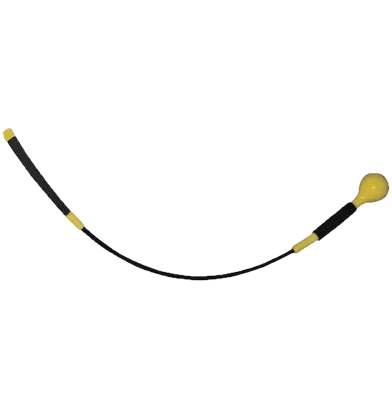
The SKLZ Gold Flex is the most popular Orange Whip alternative on the market, and for good reason — it’s roughly half the price and delivers a similar tempo-training experience, if not quite the same feel.
The construction is familiar: a weighted head, a flexible fibreglass shaft, and a counterweighted grip. Swing it smoothly and the motion flows. Rush the takeaway or throw your arms at it, and the shaft whips out of sync, giving you clear feedback that something’s wrong. Regular use builds the habit of a controlled backswing and a body-led downswing.
Where it differs from the Orange Whip is length and feel. The Gold Flex is shorter (roughly 40 inches), which makes it easier to swing in tight indoor spaces like a garage, conservatory, or spare room. Most reviews acknowledge that the shaft feel is slightly less refined than the Orange Whip — it’s a budget alternative rather than a direct equal — but for a club golfer who wants a weighted swing trainer for warm-up, tempo work, and general strength, the Gold Flex offers most of the benefit at a much more accessible price.
It’s also well-suited as a year-round fitness aid. Swinging it 20–30 times a day through the winter maintains the golf-specific muscles that otherwise atrophy during the off-season, so you start the spring with a stronger, more coordinated swing.
- PROS:
- Significantly cheaper than the Orange Whip while offering most of the same tempo-training benefit.
- Shorter length makes it practical for indoor practice where full-length trainers won’t fit.
- Established SKLZ brand with a long track record and good availability on Amazon.co.uk.
- CONS:
- Shaft feel is less refined than the Orange Whip — acceptable for most, but dedicated tempo-focused golfers may notice.
- Like all weighted trainers, it won’t fix mechanical faults like slice, hook, or poor contact.
SCORE: 8/10
Orange Whip Golf Swing Trainer
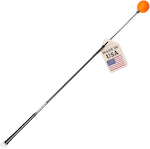
The Orange Whip is the original weighted swing trainer and still the benchmark every other tempo aid is measured against. Designed by PGA professional Jim Hackenberg, it’s used by tour players, coaches, and club golfers worldwide — including past winners like Henrik Stenson.
The concept is simple but clever. A weighted orange ball sits at the end of a flexible shaft, with a counterweight at the grip end. When you swing it, you can’t force the motion — the weight and flex physically prevent you from rushing the takeaway, casting the club from the top, or losing balance at finish. The only way to swing it smoothly is to use your body correctly: a controlled backswing, a proper pause at the top, and a sequenced downswing that starts from the ground up.
For club golfers, this addresses the two biggest issues in the amateur swing — poor tempo and weak sequencing. Most amateurs rush the transition and throw their arms at the ball, which kills power and consistency. A few swings with the Orange Whip before a round (or 20–30 swings a day at home) rebuilds the correct motion without you having to think about positions.
It also works as a warm-up tool — the weighted head loosens the shoulders, hips, and core in a way that mimics the golf swing better than stretches. Available in standard (47″), mid-size (43″), and compact (35.5″) versions — choose based on your height and whether you’re practising indoors or out.
- PROS:
- Enforces correct tempo and sequencing — you physically can’t swing it well with a rushed or arms-only motion.
- Excellent pre-round warm-up tool that loosens the muscles used in the golf swing.
- Built in the USA with a two-year warranty — durable enough to last years of daily use.
- CONS:
- Standard 47″ version needs space — not ideal for tight indoor areas unless you choose the compact version.
- More expensive than most imitator products, though build quality justifies the difference.
- Won’t fix specific swing faults like slice or fat contact — it’s a feel and tempo trainer, not a mechanics trainer.
SCORE: 8/10
CHAMPKEY Golf Swing Trainer
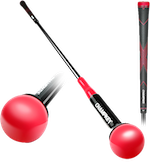
The CHAMPKEY Golf Swing Trainer is a budget-friendly weighted warm-up stick that targets many of the same swing problems as the Orange Whip at a fraction of the price. It features a weighted head and semi-flexible shaft designed to build strength, promote smoother tempo, and loosen the muscles used in the golf swing.
For club golfers who want the benefits of a weighted trainer without spending over £100, this is a solid entry-level option. The weight forces you to slow down your backswing and use your body rather than your arms — the same fundamental benefit that makes the Orange Whip effective. It won’t give you quite the same feel or feedback as the more expensive aids, but for a casual user who wants something to warm up with before a round or get a few reps in at home, it does the job.
The single-piece design means there’s no setup or adjustment — pick it up and swing. It’s suitable for indoor or outdoor use provided you have clearance for a full swing, and doubles as a light strength-training tool for building golf-specific muscles over winter.
The trade-off for the lower price is in the feedback quality. The shaft flex is less pronounced than dedicated tempo trainers, so it’s better suited to golfers who want general conditioning and warm-up rather than precise tempo diagnosis.
- PROS:
- Significantly cheaper than the Orange Whip while offering similar core benefits.
- Weighted construction builds golf-specific strength, which can help with clubhead speed over time.
- Single-piece design — no assembly, no adjustments, ready to swing out of the box.
- CONS:
- Shaft flex is less refined than premium tempo trainers, so feedback is more general than targeted.
- Doesn’t address specific swing faults — best treated as a warm-up and conditioning aid rather than a technique trainer.
SCORE: 7/10
Tour Striker Smart Ball
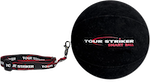
The Tour Striker Smart Ball is one of the smallest and cheapest training aids on this list, but it targets a genuinely common problem for club golfers — disconnection between the arms and body during the swing.
Here’s the issue it solves: when your arms separate from your body on the backswing or downswing, you lose rotational power, struggle with consistent ball striking, and often end up with a slice. The Smart Ball is an inflatable ball that you hold between your forearms while you swing. If your arms stay connected to your body’s rotation, the ball stays in place. If your arms disconnect — whether by lifting in the backswing, casting from the top, or chicken-winging through impact — the ball drops.
It’s designed by Martin Chuck, a well-regarded PGA instructor, and works across the bag. You can use it with a wedge to feel connection in chip shots, with an iron to groove a compact full swing, or even with a putter to keep the stroke connected to the shoulders. This versatility is what makes it useful — most swing trainers work for one specific drill.
It won’t help with swing plane, grip, or alignment, and you’ll need to spend time getting used to the feel of swinging with something tucked between your arms. But for golfers who’ve been told by a coach or video analysis that their arms get “disconnected” from their body, this is one of the simplest and cheapest ways to fix it.
- PROS:
- Targets a specific, common swing fault (arm-body disconnection) that causes slices and inconsistent contact.
- Works across the bag — wedges, irons, full swings, even putting.
- Inflatable design packs flat and weighs almost nothing — easy to take to the range or on holiday.
- CONS:
- Requires correct positioning between the forearms to give meaningful feedback — takes practice.
- Won’t address grip, alignment, swing plane, or other common swing issues.
- Some users find it uncomfortable or distracting until they get used to the feel.
SCORE: 8/10
Tour Pro Golf Lag Swing 7 Iron
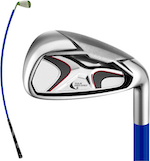
The Tour Pro Golf Lag Swing 7 Iron is a practice club shaped like a standard 7-iron but fitted with an extremely flexible shaft. The purpose is to exaggerate the loading and unloading of the club during the swing, making it obvious where your transition and tempo break down.
Here’s why it works. In a good golf swing, the shaft subtly bends backwards during the transition from backswing to downswing — this is “lag” and it’s the key to generating clubhead speed and compression at impact. Most amateurs either don’t lag the club at all (casting from the top) or lose lag too early in the downswing. Both problems cost distance and consistency.
Because the Lag Swing 7 Iron’s shaft is super-flexible, these faults become impossible to hide. If you cast the club, the shaft flops around and you’ll feel it immediately. If your transition is rushed, the timing falls apart. The only way to swing it cleanly is with a proper, sequenced motion — body leading, arms following, wrists unhinging at the right moment.
It’s shaped like a familiar 7-iron rather than a whippy stick, which helps some golfers make the connection to their real swing more easily than with Orange Whip-style trainers. It’s a repeating-motion aid for practice sessions rather than a feedback tool for precision work — don’t expect to hit accurate shots with it.
Note that it’s built for right-handed golfers only, which is an obvious limitation.
- PROS:
- Super-flexible shaft makes poor tempo and early release immediately obvious.
- Iron-shaped head provides a more familiar feel than whip-style trainers — easier mental transfer to your real swing.
- Useful for pre-round warm-up and ingraining a properly sequenced transition.
- CONS:
- Right-handed only — no left-handed version available.
- Exaggerated shaft flex isn’t suitable for working on strike or accuracy.
SCORE: 7/10
Frequently Asked Questions
Do golf swing trainers actually work?
Yes — when used correctly and for the right reasons. A swing trainer won’t magically fix a slice or add 30 yards to your drives overnight, but it will ingrain the fundamentals that most club golfers lack: controlled tempo, proper sequencing, and a connected swing. The key is consistency. Using a swing trainer for 10–15 minutes a day, several times a week, will produce noticeable improvements in rhythm and ball striking within a few weeks. It’s also worth remembering that swing trainers give you feedback you can’t get from just swinging a club — which makes practice genuinely productive rather than repetitive.
Which swing trainer is best for beginners?
For golfers who are new to the game or returning after a break, a weighted tempo trainer like the Orange Whip or SKLZ Gold Flex is usually the best starting point. Beginners tend to swing with their arms, rush the transition, and lose balance — all problems a weighted trainer exposes immediately. It also doubles as a warm-up and strength-building tool, which helps build golf-specific fitness without requiring a gym. If budget is tight, the SKLZ Gold Flex covers the same ground as the Orange Whip at a lower price.
Can I use a swing trainer indoors?
It depends on the trainer and the space you have. Compact trainers like the Orange Whip Compact (35.5″) or SKLZ Gold Flex (40″) fit in most rooms with standard ceilings, though you’ll still need clearance for a full swing. The full-size Orange Whip (47″) requires more room and is really designed for outdoor or garage use. Smaller training aids like the Tour Striker Smart Ball can be used anywhere because you’re not making a full swing with a club. Always check ceiling and wall clearance before your first swing indoors — a weighted trainer can do real damage to a light fitting.
How long should I practise with a swing trainer?
Short, regular sessions are far more effective than long, occasional ones. For tempo and warm-up trainers like the Orange Whip or SKLZ Gold Flex, 20–30 swings a day is plenty — you’re building rhythm and muscle memory, not exhausting yourself. For connection aids like the Smart Ball, work in short bursts of 10–15 swings with specific focus on feeling the arm-body connection, then stop. Five minutes of focused practice beats 30 minutes of mindless repetition every time. Most golfers see the biggest benefit from using a swing trainer as part of their pre-round warm-up rather than as a standalone practice tool.
Will a swing trainer fix my slice?
A swing trainer can help reduce a slice but won’t cure it by itself. Slices are usually caused by an out-to-in swing path combined with an open clubface at impact — both of which come from poor sequencing (throwing the arms from the top) and disconnected rotation. Weighted trainers like the Orange Whip help by forcing you to sequence the downswing correctly, which flattens the swing path. Connection aids like the Smart Ball keep your arms working with your body rotation rather than against it. Used together, they address the root causes of most slices, though you’ll still need to check your grip and alignment — no training aid fixes those.