Best Putting Training Aids
Putting accounts for around 40% of every round, yet most club golfers rarely practise it. The best putting training aids can help you build a repeatable stroke, sharpen your alignment, and develop the kind of pace control that eliminates three-putts — all without leaving the house.
We’ve reviewed five of the best putting training aids available on Amazon.co.uk, each targeting a different part of your putting game. Here’s what they do, who they suit, and whether they’re worth your money.
Product Reviews
EyeLine Golf Putting Training Aid
If your putts consistently miss in one direction and you can’t work out why, the problem is almost certainly in your setup — not your stroke.
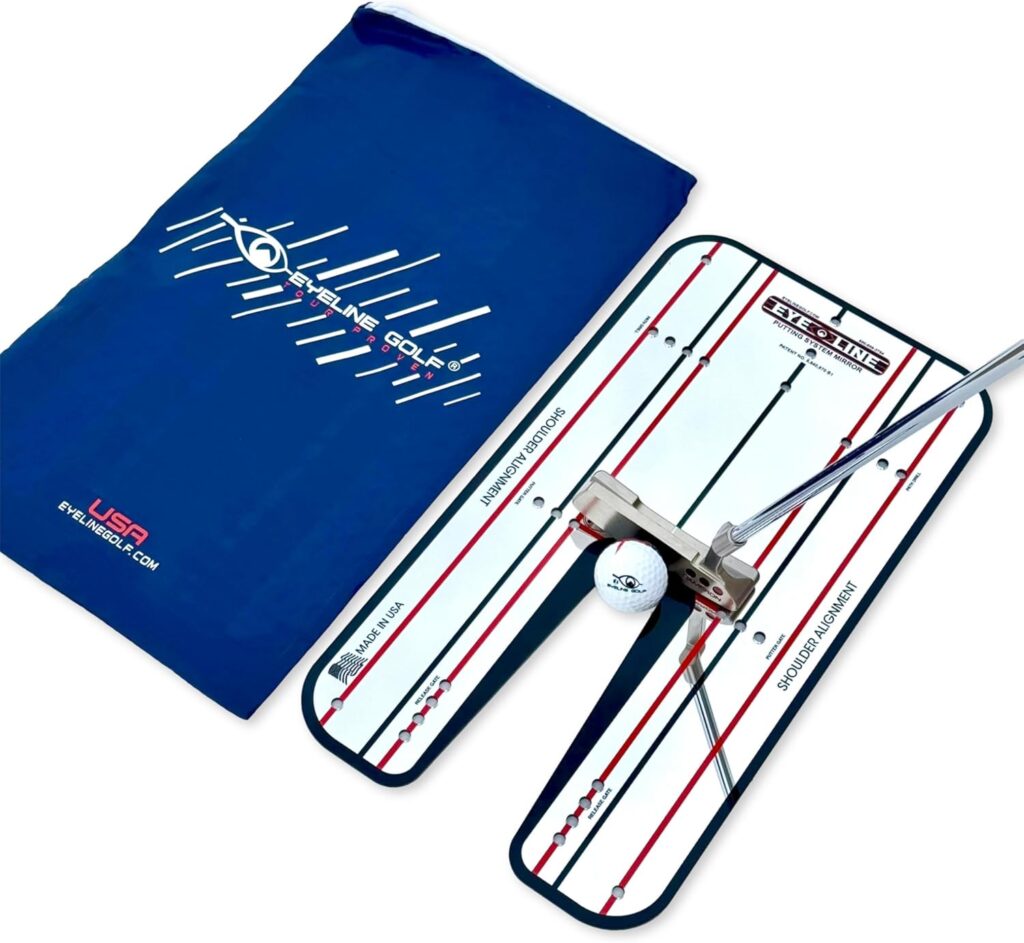
The EyeLine Golf Classic Putting Mirror is designed to fix exactly that. Place it on the ground, address the ball, and the mirror instantly shows you where your eyes are positioned, whether your shoulders are square, and how your putter face sits at address.
It’s one of the most widely used putting aids on professional tours for a reason: getting your eyes directly over the ball and your shoulders aligned to the target line is the foundation of consistent putting. Without it, even a technically good stroke will send the ball offline.
The built-in gate slots on the mirror let you add tees to create a simple stroke-path drill, giving feedback on whether your putter is travelling straight through impact.
It won’t help with pace or distance control — this is purely a setup and alignment tool — but for club golfers who’ve never checked their eye position over the ball, the results can be immediate.
Slim enough to carry in your golf bag and supplied with a protective carry case. Works equally well on an indoor putting mat or on the practice green at your course.
- PROS:
- Shows you exactly where your eyes, shoulders, and putter face are at address — the most common source of missed putts for club golfers.
- Gate slots let you run basic stroke-path drills with tees to check putter face angle through impact.
- Lightweight and portable with a carry case — easy to use at home on carpet or on the cours
- CONS:
- Setup feedback only — doesn’t help with pace, distance control, or stroke tempo.
- Mirror surface can reflect sunlight outdoors, which some golfers find distracting.
SCORE: 8/10
PuttOUT Pro Putting Gates
Most missed putts inside six feet come down to one thing: the putter face isn’t square at impact. Even a degree or two of misalignment sends the ball wide of the hole, and the frustrating part is you can’t feel it happening. The PuttOUT Pro Putting Gates make that invisible problem visible.
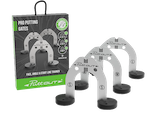
The set includes three gate widths — wide, medium, and narrow — each providing a progressively tighter window that the ball must pass through cleanly. Start with the widest gate to build confidence, then narrow it as your face control improves. If the ball clips a gate, your face was open or closed at impact. Simple, immediate feedback with no guesswork.
The gates are made from foldable aluminium with weighted rubber feet, so they stay put on carpet, putting mats, or outdoor greens without sliding. They’re compact enough to fold flat and fit in the included carry pouch.
This is a focused tool — it trains putter face angle at impact and nothing else. But given that face angle is responsible for roughly 80% of your putt’s starting direction, it’s arguably the single most impactful thing a club golfer can practise. Pairs well with a putting mat or the PuttOUT Pressure Trainer for a complete indoor setup.
- PROS:
- Three progressive gate widths give clear, scalable feedback on putter face angle at impact.
- Weighted rubber feet keep gates stable on carpet, mats, or grass — no fiddly setup.
- Foldable aluminium design with carry pouch makes them easy to store or take to the course.
- CONS:
- Requires a reasonably flat surface — uneven carpet or bumpy greens can affect ball path and give misleading feedback.
- Trains face angle only — doesn’t cover alignment, speed control, or stroke path.
SCORE: 8/10
PERFECT PRACTICE Perfect Putting Mat
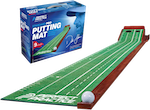
If you want to practise putting at home but don’t have access to a practice green, an indoor putting mat is the most practical solution — and the PERFECT PRACTICE Putting Mat is one of the most popular options on the market. At 9.5 feet, it’s long enough to practise genuine 3- to 8-foot putts rather than just tapping balls from a couple of feet away.
The crystal velvet surface rolls at roughly 10–14 on the stimpmeter depending on what’s underneath it (faster on hard floors, slower on thick carpet), which puts it in the range of a medium-to-fast course green. Printed distance markings along the mat give you reference points for structured practice — set yourself targets, track consistency from each distance, and build a routine rather than just aimlessly rolling putts.
Two regulation-size holes at the far end sit within a wooden backstop that returns missed putts, which keeps practice flowing without constantly walking to retrieve balls. The mat rolls up for storage, though at nearly 10 feet it does need a decent amount of floor space when laid out.
The main limitation is that it’s a flat, straight surface — you won’t practise reading breaks or adjusting for slope. But for grooving a consistent stroke, building confidence on short putts, and developing feel for pace, it’s a solid home practice tool that actually gets used because it’s convenient.
- PROS:
- 9.5-foot length allows realistic practice from genuine short-putt distances, not just tap-ins.
- Printed distance markers support structured practice drills rather than aimless putting.
- Ball return system keeps practice flowing — no need to walk and retrieve balls after every putt.
- CONS:
- Flat, straight surface only — won’t help you practise reading breaks or putting on slopes.
- Requires around 10 feet of clear floor space, which may be tight in smaller rooms.
- Surface speed varies depending on what’s underneath — results differ between carpet and hard floors.
SCORE: 7/10
PuttOut Premium Pressure Putt Trainer

The PuttOUT Premium Pressure Putt Trainer is one of the bestselling putting aids in the UK, and for good reason — it’s simple, compact, and gives you something most practice setups lack: honest feedback on your pace.
The concept is straightforward. A parabolic ramp sits at the end of your putting line. If your putt has the right line and the right pace, the ball rolls up the ramp and comes back to you — saving you from fetching it. If you hit it too hard, the ball overshoots and the ramp shows you how far past the hole it would have run. Hit the micro-target at the top of the ramp (which requires pace of roughly 18 inches past the hole on a perfect line) and the ball stays — that’s your “perfect putt.”
What makes this particularly useful for club golfers is the pace education. Most amateurs leave putts short, never giving the ball a chance to drop. Using the Pressure Trainer regularly builds the habit of rolling the ball past the hole with authority, which is one of the simplest ways to make more putts on the course.
It folds flat for storage or travel, works on carpet, putting mats, or outdoor greens, and pairs naturally with PuttOUT’s putting mat and mirror for a complete home setup. PuttOUT is a London-based company, so UK availability and delivery from Amazon.co.uk is straightforward.
- PROS:
- Parabolic ramp gives immediate, visual feedback on whether your pace would have made or missed the putt.
- Micro-target rewards the ideal putt speed (18 inches past the hole), building a habit most club golfers need.
- Folds completely flat — fits in a golf bag, desk drawer, or next to a putting mat at home.
- CONS:
- Needs a flat surface to provide consistent feedback — thick or uneven carpet can affect the roll.
- Trains pace and line on straight putts only — doesn’t replicate breaking putts or green contours.
- Addictive — genuinely hard to stop once you start chasing the perfect putt.
SCORE: 8/10
PuttOut Putting Mirror Trainer and Alignment Gate
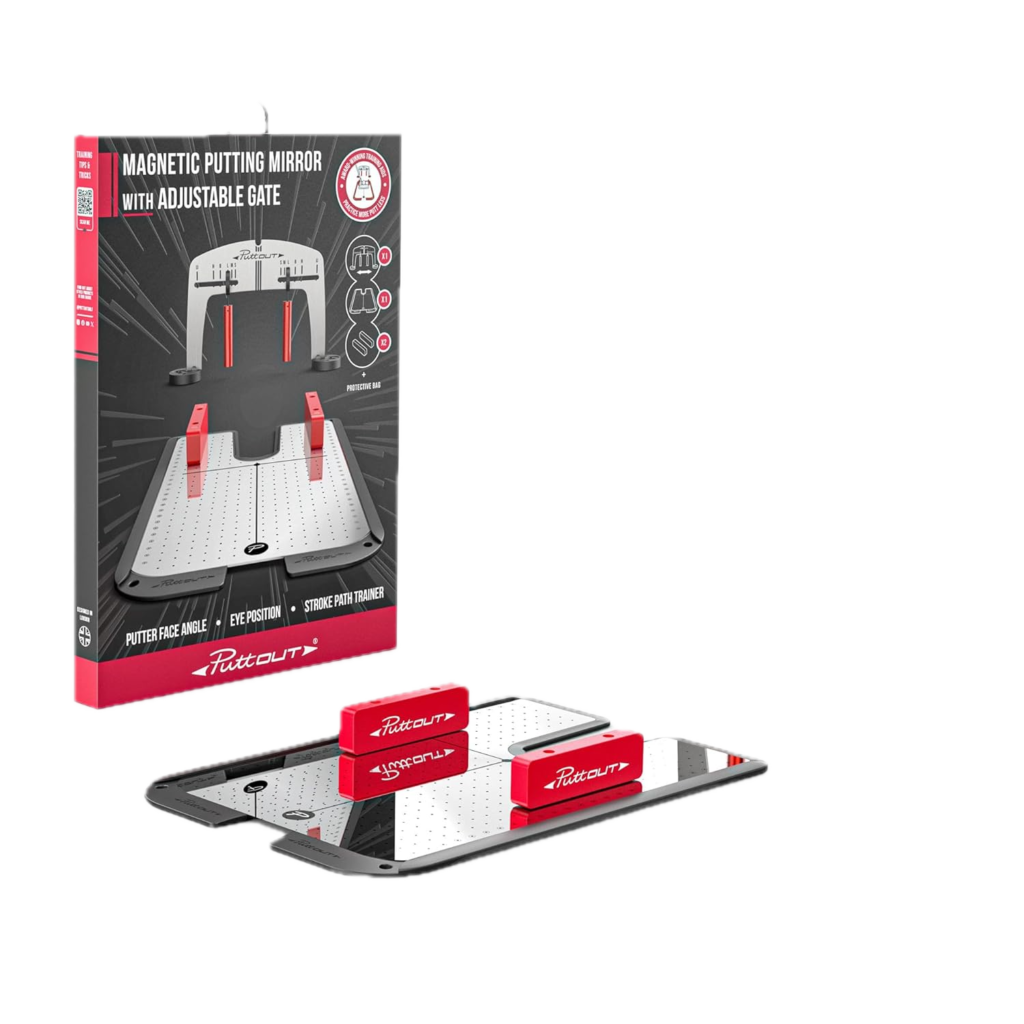
The PuttOUT Putting Mirror Trainer and Alignment Gate combines two training functions in one package: a putting mirror for checking your setup, and a 50mm putting gate for testing your start line through impact.
The mirror works like the EyeLine mirror reviewed above — stand over the ball and the reflective surface shows your eye position, shoulder alignment, and putter face angle.
Where the PuttOUT version differs is in the adjustable magnetic putter guides built into the mirror. These guides create a channel for your putter head, giving you tactile and visual feedback on whether your stroke path is consistent through the hitting zone.
You can adjust the guide width to tighten tolerances as you improve. The included 50mm putting gate adds a second drill: place it a few inches in front of the ball and putt through it. If the ball passes cleanly through the gate, your face angle and start line are good.
If it clips a side, you know which way the face was pointing at impact. This is a setup-and-stroke mechanics tool. It won’t help with distance control or green reading, but it covers the fundamentals that most putting problems stem from — particularly for club golfers who’ve never systematically checked whether their eyes are over the ball or their shoulders are aligned to the target.
Like all PuttOUT products, the build quality is a step above cheaper alternatives. The mirror has an anti-scratch surface and spiked rubber feet to prevent it sliding during use.
Works on indoor mats or outdoor greens.
- PROS:
- Mirror and magnetic stroke guides combine setup checking and stroke path training in one compact tool.
- Included 50mm putting gate adds start-line and face-angle drills straight out of the box.
- Anti-scratch mirror surface with spiked rubber feet — stays in place and built to last.
- CONS:
- Focuses on setup and stroke mechanics only — no pace or distance control training.
- Requires a flat surface and careful positioning to give accurate visual feedback.
- More expensive than a basic putting mirror, though you’re getting the gate included.
SCORE: 8/10
Frequently Asked Questions
Do putting training aids actually work?
Yes — but only if you choose one that targets the specific part of your putting that needs improving. A putting mirror won’t help if your problem is pace control, and a pressure trainer won’t fix a misaligned setup. The key is diagnosing your weakness first. If you consistently miss putts in one direction, start with an alignment mirror. If you’re always leaving putts short or running them well past, a pressure trainer or putting mat with distance markers will help more. Training aids provide feedback you can’t get from just rolling putts at a hole, and even 10 minutes of focused practice a few times a week can make a noticeable difference on the course.
What is the best putting training aid for beginners?
For golfers who are relatively new to the game or haven’t used training aids before, a putting mirror is the best starting point. Most putting problems for beginners start at setup — eyes not over the ball, shoulders misaligned, putter face not square — and a mirror shows you all of this instantly. The EyeLine Golf Classic Putting Mirror is a straightforward, affordable option. Once your setup is consistent, adding a putting mat and pressure trainer gives you a complete home practice station.
Can I practise putting on carpet at home?
You can, and it’s better than not practising at all. Carpet gives you a surface to work on stroke mechanics, alignment, and face angle — all of which transfer to the course. The main limitation is that carpet is slower and less consistent than a real green, so distance control practice won’t be fully realistic. A dedicated putting mat solves this by providing a smoother, faster, more consistent surface that better replicates green speeds. If you’re serious about home practice, a mat is a worthwhile upgrade, but carpet with a mirror or gate is still a productive way to practise.
Which putting training aid should I buy first?
It depends on where you’re losing strokes. If you don’t know why you’re missing putts, start with a putting mirror — it will quickly reveal setup issues you didn’t know you had. If your setup feels solid but you struggle with pace (leaving putts short or blasting them past), the PuttOUT Pressure Putt Trainer is an excellent choice. If you want a complete home practice setup in one purchase, a putting mat with distance markers gives you the most versatility. Many golfers find that combining two aids — a mirror for setup checks plus a mat or pressure trainer for stroke practice — covers most of what they need.
How long should I practise putting at home each day?
You don’t need long sessions to see improvement. Research into motor learning suggests that short, focused practice is more effective than long, unfocused sessions. Even 10 to 15 minutes a day, three to four times a week, is enough to build meaningful improvement in your stroke consistency and confidence — provided you’re practising with purpose rather than just aimlessly rolling putts. Using a training aid that gives you clear feedback (like a mirror, gate, or pressure trainer) makes those minutes far more productive than putting without one.