Best Golf Alignment Aids
Ask any tour player what’s in their practice kit. Almost all answer the same. Alignment sticks are the best golf alignment aids in professional golf and the most underused by club golfers. Poor alignment is the single most common reason amateurs miss greens. Amateurs also hit slices they can’t explain.
Good news: the best golf alignment aids are cheap and simple. These aids work for every part of the game, including full swing, chipping, and putting. They also support posture and ball position. We’ve reviewed five of the best available on Amazon.co.uk, including four sets of alignment sticks and one setup tool that works alongside them. Here’s what each does, who it suits, and which is worth buying.
Product Reviews
Callaway Alignment Stix Training
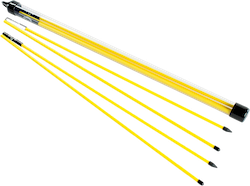
Callaway Alignment Stix are the most recognised alignment sticks on the market. For most club golfers, they’re the sensible default choice. You pay a modest premium over unbranded alternatives for the Callaway name. Additionally, you receive reliable quality from a brand that won’t cut corners on fibreglass rods.
The set includes two 48-inch shock-corded sticks and a protective storage tube. Shock-corded sticks fold down into shorter sections for transport. They snap back into full-length rods when needed. This is a genuinely useful feature for carrying them in your golf bag or travelling to the range.
Like all alignment sticks, what makes them valuable is how many drills they cover. Place one stick on the ground pointing at your target. Another lies parallel across your toes for instant alignment feedback. Stick one vertically behind the ball to check swing path. Use them to frame your ball position, check posture, groove a square putter face — the list goes on.
For club golfers who’ve never used alignment sticks, the first few sessions are often a revelation. Most amateurs aim 10–15 yards right of where they think they’re aiming, and no amount of swing work fixes misses caused by poor alignment. A pair of sticks and 10 minutes on the range will often expose the problem immediately.
- PROS:
- Trusted Callaway brand with reliable build quality — won’t snap or bend like cheaper alternatives.
- Shock-corded design folds down for easy bag storage and travel.
- Supplied with a protective tube to prevent damage in the bag.
- CONS:
- More expensive than generic alignment stick sets that do essentially the same job.
- Only two sticks — some drills work better with a three-stick setup.
SCORE: 8/10
Tour Aim Alignment Stick Adapter
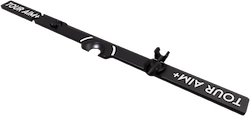
The Tour Aim Alignment Stick Adapter is a different kind of product from the rest of this list. Rather than replacing alignment sticks, it works alongside them to create a more structured pre-shot setup routine. It’s a compact plastic base with slots for alignment sticks, a built-in tee holder, and reference marks for checking aim, face angle, and ball position.
The idea is simple. Instead of laying sticks on the ground and trying to get them parallel by eye, you slot them into the Tour Aim base, which locks them into a precise, repeatable setup every time. This saves time on the range and eliminates the guesswork of whether your sticks are genuinely parallel to the target line.
The built-in tee holder is a small but useful touch — it lets you use real tees on a practice mat, which most range mats don’t allow. There are also alignment marks on the base itself to help with ball position and putter face angle, so it doubles as a short-game setup tool.
The main limitation is that it’s a setup-only aid. Once you start your swing, the Tour Aim doesn’t give you any feedback — that’s what the sticks are for. You’ll also need to buy alignment sticks separately to get the full benefit (though most golfers who would consider this already own a set).
It’s a useful purchase for golfers who want to take alignment seriously but struggle to set up drills consistently on their own. For casual users, a standard pair of alignment sticks is probably enough.
- PROS:
- Locks alignment sticks into a precise, repeatable setup — no more guessing if they’re parallel.
- Built-in tee holder makes it easier to use real tees on range mats.
- Doubles as a setup tool for putting, ball position, and face angle drills.
- CONS:
- Setup aid only — no feedback once the swing begins.
- Requires alignment sticks to be purchased separately for full functionality.
- Best suited to regular range-goers who want structured practice, rather than casual users.
SCORE: 7/10
Rhino Valley Golf Alignment Sticks
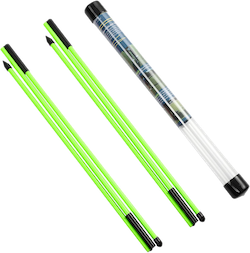
The Rhino Valley Golf Alignment Sticks are a budget-friendly alternative to the Callaway set, with one useful feature the Callaways don’t have: they collapse into three sections rather than two. That smaller folded size makes them genuinely easy to pack — they fit inside a golf bag pocket rather than sticking out of the club section.
Functionally they do exactly what any pair of alignment sticks does: provide a straight visual reference for alignment, ball position, swing path, and posture. The fibreglass construction is light and durable, the pointed ends stick into grass or practice mats, and the included storage tube keeps them protected in the bag.
If you travel with your clubs or simply don’t like having alignment sticks poking out of your bag, the collapsible design is a real practical advantage. Packing them into a suitcase or taking them on a weekend golf trip is much easier than carrying full-length rods.
The trade-off is a slight feel compromise. Three-section sticks have two joints, which very occasionally flex or show a seam — most users never notice, but if you want a single unbroken rod, the Callaway or SuperStroke options are better. For everyday range use and portability, the Rhino Valley set is a smart, affordable choice.
- PROS:
- Three-section collapsible design packs down smaller than standard alignment sticks.
- Significantly cheaper than branded alternatives like Callaway.
- Fibreglass construction with pointed ends works on grass, mats, or indoor practice surfaces.
- CONS:
- Jointed design has two small seams — not visible in normal use, but worth noting.
- Unbranded product with less long-term reputation than Callaway or SuperStroke.
SCORE: 8/10
FINGER TEN Golf Alignment Sticks
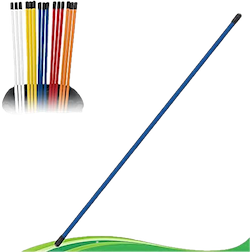
The FINGER TEN Alignment Sticks stand out from the others on this list for one reason: you get three sticks rather than two. For most drills, two sticks is enough — one for target line, one for body line — but a third stick unlocks a range of setups that two-stick sets can’t cover.
Examples: lay two sticks on the ground to frame your target line, then use the third vertically behind the ball to check swing path. Or use one for alignment, one for ball position, and one as a reference point for club path through impact. Coaches frequently use three-stick setups, and having the third stick means you don’t need to keep moving a single rod around between drills.
The sticks themselves are full 48-inch fibreglass rods — non-collapsible, so they’re longer than the Rhino Valley set when stored. They come with a clear tube that keeps them together in the bag, though some golfers find the tube bulky.
At roughly the same price as a two-stick Callaway set, you’re getting an extra stick for the same money — which makes this a solid value choice for golfers who want more drill variety. The main compromise is size. If you want portability above all else, the Rhino Valley collapsible set is better. If you want more setup options at a reasonable price, the FINGER TEN three-pack is the smarter buy.
- PROS:
- Three sticks instead of two — more drill variety for the same money as branded two-stick sets.
- Full 48-inch length gives a long, clear visual reference for alignment.
- Works indoors, on the range, on the short-game area, or at home on carpet.
- CONS:
- Non-collapsible design makes them longer to store than jointed sets.
- Storage tube is bulky when packed with three sticks.
SCORE: 8/10
SuperStroke Golf Alignment Sticks 45″
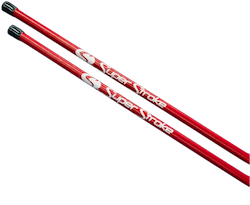
The SuperStroke Alignment Sticks are a no-nonsense pair of 45-inch fibreglass rods from a brand better known for its putter grips. They don’t have the shock-corded flexibility of the Callaway set, the collapsible design of the Rhino Valley, or the three-stick value of the FINGER TEN — they’re simply a solid, durable pair of alignment sticks with a protective travel tube.
For many golfers, that’s all they need. Alignment sticks aren’t a product where advanced features make a big difference — what matters is that they’re straight, durable, and easy to pack. The SuperStroke sticks tick all three boxes. The bright red colour stands out against grass, which is genuinely useful on the range when you’re trying to focus on where you’re aimed.
At 45 inches, they’re slightly shorter than the 48-inch rods that most other brands offer. For most drills this makes no practical difference, but taller golfers or those using them for full-length body alignment may prefer the extra few inches on a 48-inch set.
Choose these if you want a reliable branded pair without paying the Callaway premium, and don’t specifically need the collapsible or three-stick features of other sets.
- PROS:
- Durable fibreglass construction from an established golf brand.
- Bright red colour is easy to see on grass or practice mats.
- Includes a protective travel tube.
- CONS:
- 45-inch length is slightly shorter than most competitors’ 48-inch sticks.
- No shock-cord or collapsible design — takes up more bag space than folding alternatives.
SCORE: 8/10
Frequently Asked Questions
Do alignment sticks actually improve your game?
Yes — more than almost any other training aid, which is why they’re the most-used practice tool on professional tours. Most amateur golfers aim significantly further right (or left) of their target than they realise and no amount of swing work can fix a miss caused by poor alignment. Laying a stick on the ground pointing at your target gives you instant visual feedback on where you’re actually aimed versus where you think you’re aimed. For most golfers, the first few range sessions with alignment sticks produce immediate improvement in shot direction and consistency.
What’s the difference between cheap and expensive alignment sticks?
Surprisingly little, in practical terms. All alignment sticks are essentially straight fibreglass rods — what you’re really paying for with branded sets (like Callaway or SuperStroke) is reliable quality control, durable construction, and in some cases features like shock-cording or collapsible sections. Generic alternatives work just as well for most drills. The main risks with very cheap sets are bent rods out of the box, weak pointed ends that break off, or tubes that split after a few weeks. Spending slightly more for a known brand is usually worth it, but you don’t need to spend a lot.
How many alignment sticks do I need?
Two sticks are enough for most drills — one for your target line and one for your body line. A third stick adds more setup options, like checking swing path or ball position while keeping target and body lines in place. If you’re new to alignment sticks, start with a two-pack. If you’re a regular range user who wants to build structured drills, a three-pack like the FINGER TEN set gives you more flexibility.
Can I use alignment sticks indoors?
Yes. Alignment sticks don’t require you to swing a club, so they work anywhere you have space to lay them on the ground. Common indoor uses include checking putting stroke path on a mat or carpet, working on setup and ball position for short irons, and practising body alignment in front of a mirror. If you have a practice net or indoor simulator, a pair of alignment sticks is one of the most useful accessories you can own.
Are alignment sticks allowed during a round?
You can use alignment sticks during practice swings and pre-round warm-up, but you’re not allowed to use them for alignment during play under the Rules of Golf (Rule 10.2b). Placing an object on the ground to help aim at the target is prohibited. Alignment sticks are strictly for practice — but that’s where the improvement happens anyway, so it’s not a meaningful limitation.