Best Golf Grip Trainers
The grip is the only contact point between you and the club. Most club golfers have never had theirs properly checked. Best golf grip trainers are designed to address that. They fix the grip, and many other problems begin to fix themselves.
We’ve reviewed five of the best golf grip trainers available on Amazon.co.uk. These include clip-on aids, moulded replacement grips, and removable training attachments. Four of the five are designed for right-handed golfers; one is specifically for left-handers. Here’s what each one does, who it suits, and which is worth adding to your practice routine.
Product Reviews
SKLZ Unisex Grip Gold Trainer
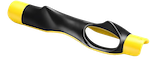
The SKLZ Golf Grip Trainer is a clip-on training aid. It attaches over your existing grip and guides your hands into the correct neutral position. It ranks among the best-selling grip trainers available. The moulded shape guides hands into the correct neutral position. Place your hands on it and there’s only one comfortable position: the right one.
Here’s the problem it solves. Most club golfers form their grip by feel. This perception often seems natural, yet the grip is actually too strong. It may be too weak or vary from shot to shot. An incorrect grip forces the hands to compensate through impact. This compensation can square the face at impact. That habit reliably produces blocks, hooks, and fat contact under pressure. A training grip removes that guesswork entirely by making the correct hand position physically obvious.
The SKLZ version clips on and off. You can use it across multiple clubs during a practice session. For example, work on your grip with a 7-iron, then transfer it to a wedge for short-game practice. The included video tutorials are a useful addition for complete beginners. They seek context for what they’re doing and why hand position matters.
The fixed moulded shape is the main limitation — as with all moulded grip trainers, it’s calibrated for a neutral grip. Golfers who deliberately play a strong or weak grip for shot-shaping reasons will find it fights their natural hand position. Most club golfers want a more consistent, repeatable grip. This is one of the simplest ways to build that habit.
- PROS:
- Clip-on design works across multiple clubs — attach it to any iron or wedge during practice without permanent installation.
- Ergonomic moulded shape makes the correct neutral hand position immediately obvious, removing guesswork.
- Includes video tutorials, which help beginners understand why the grip matters rather than just how to hold the club.
- CONS:
- Fixed neutral shape won’t suit golfers who intentionally play a strong or weak grip.
- Right-handed design only — left-handed golfers should look at the Lamkin option below.
SCORE: 7/10
SUNTRADE Golf Club Grip
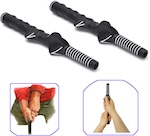
The SUNTRADE Golf Training Grip is a moulded rubber training grip that replaces your existing grip on a club, rather than clipping over it. The set includes two grips, which gives you options the single-grip alternatives don’t — dedicate one club in your bag to grip training, keep a spare for a second club, or hold one back as a replacement when the first wears out.
The moulded rubber construction does the same job as any training grip: it defines where your hands and fingers should sit, so you feel immediately when something is off. The advantage of a replacement grip over a clip-on is that it stays in place — there’s no risk of it rotating or sliding during a swing, and nothing to attach or remove between shots. You just pick up the club and practise.
For club golfers who want to dedicate a specific club to grip training — a 7-iron is the most practical choice, since it’s long enough to practise a full swing but forgiving enough that you’re not fighting loft and length while working on fundamentals — this is a sensible, affordable way to do it. The two-grip set gives you better value than most single-grip alternatives at a similar price.
The same limitation applies as with all moulded grips: the fixed hand position is calibrated for a neutral grip. If you play with a strong right-hand position, the moulded shape will feel wrong — which is partly the point, but may be frustrating for experienced golfers who have developed a deliberate grip style that works for them.
- PROS:
- Supplied as a set of two — dedicate a club to grip training and keep a spare, or use across two different clubs.
- Full replacement grip stays firmly in place during swings — no sliding or rotation between shots.
- Good value for money compared with single-grip alternatives at a similar price point.
- CONS:
- Fixed moulded shape is calibrated for a neutral grip — won’t suit golfers who deliberately play strong or weak.
- Right-handed design only.
SCORE: 8/10
G-Rip Mens Golf Training Grip Right Handed

The G-Rip Golf Training Grip is a full replacement grip with an integrated hand-position guide built directly into the rubber. Where clip-on aids add a mould over your existing grip, the G-Rip replaces the grip entirely — which means it’s always there, always in the right place, and always giving you feedback the moment your hands drift out of position.
The textured rubber surface has pronounced reference ridges that tell your fingers exactly where to sit. This tactile feedback is more subtle than the deep moulding on some training grips, which is actually a feature rather than a bug — it guides your hands without forcing them into a single fixed position in quite the same way. For golfers who find heavily moulded grips too prescriptive, the G-Rip offers a slightly more natural feel while still providing clear positional guidance.
Being a permanent replacement grip rather than a removable aid, it’s best suited to golfers who want to use a training grip throughout a full practice session without thinking about it — put it on a practice club and it’s always ready. The blue colour makes it visually distinct from standard grips, which is a minor practical benefit on a busy range where you’re juggling multiple clubs.
As with the SUNTRADE, the commitment to a permanent installation is both the strength and the limitation. You’ll want a dedicated practice club rather than fitting it to a club you play with regularly, since the training grip profile isn’t ideal for competitive rounds.
- PROS:
- Full replacement grip with integrated finger guides provides continuous positional feedback throughout a swing — no setup, no removal.
- Textured reference ridges guide hand position without the rigid fixed moulding of some alternatives — slightly more natural feel.
- Blue colour makes it easy to identify your practice club on the range.
- CONS:
- Permanent installation means you’ll need a dedicated practice club — not designed to be swapped between clubs like a clip-on.
- Fixed moulded shape won’t suit golfers who play a deliberately strong or weak grip.
- Right-handed design only.
SCORE: 7/10
Goose Golf Golf Swing Trainer
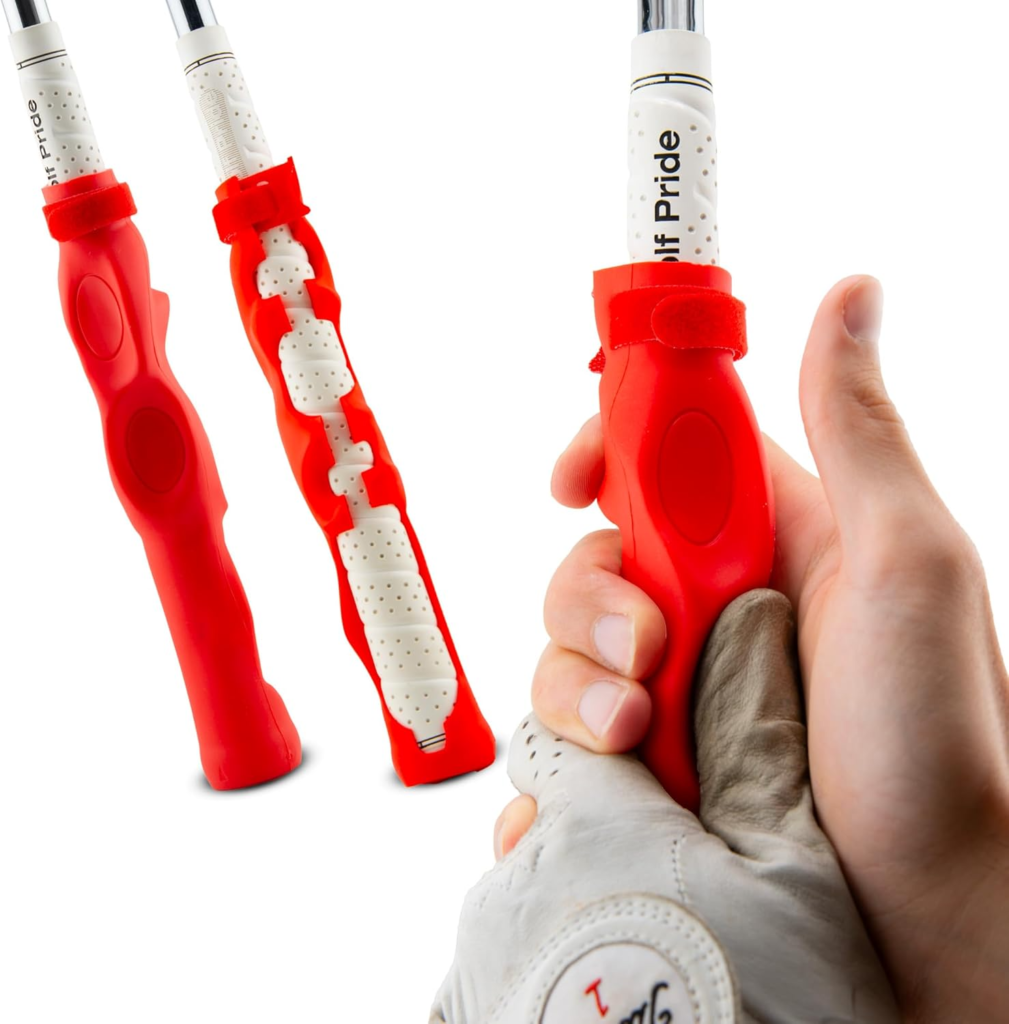
The Goose Golf Swing Trainer takes a different approach from the replacement grips reviewed above. Instead of fitting permanently to a club, it slides over your existing grip — and crucially, it’s available in multiple sizes to match different grip diameters. That size compatibility is what makes it stand out in a category where most aids are one-size-fits-all.
The contoured hand-shaped design provides clear guidance for where the fingers and palms should sit, and because it fits over the top of your existing grip, you can move it from club to club during a session. Practise your grip on a driver, transfer the Goose to a 9-iron for some short-iron work, then move it to a wedge for chipping — without buying multiple training grips or re-gripping different clubs.
The removable design also means it doubles as a diagnostic tool. Grip it on a club, take your normal grip position, and see immediately whether your hands are where they should be. For golfers who’ve been told by a coach that their grip needs work but aren’t sure exactly what “correct” looks like in practice, this is a useful way to get physical feedback you can feel rather than just watching a video.
Size availability is the genuinely useful practical feature here — if you use oversized grips (increasingly common for golfers with larger hands or arthritis), a one-size training aid often won’t fit properly. The Goose accounts for that. Check the size options carefully against your current grip diameter before buying.
- PROS:
- Available in multiple sizes to match different grip diameters — works with standard, midsize, and oversized grips.
- Removable design allows use across multiple clubs during a session without permanent installation.
- Contoured hand-shaped moulding gives clear tactile feedback on hand and finger positioning.
- CONS:
- Fixed moulded shape won’t suit golfers with a deliberately strong or weak grip.
- Suitable for right-handed golfers only.
SCORE: 8/10
Lamkin Training Grip

The Lamkin Training Grip is the only left-handed option on this list, which immediately makes it the default recommendation for left-handed golfers who want to work on grip fundamentals. Lamkin is one of the most respected grip manufacturers in golf — their rubber compounds and ergonomic designs are used by tour players and club golfers worldwide — so this isn’t a generic training product with the word “training” added to the name. It’s built to Lamkin’s usual standard.
Like the other replacement grips reviewed above, it fits onto a standard .58 round shaft and stays in place permanently. The ergonomic moulding guides the left-handed golfer’s hands into the correct neutral position, providing tactile feedback throughout the swing rather than just at address. For left-handed club golfers who’ve built their grip by feel and never had it properly checked, that feedback is often a revelation — it shows clearly how far from neutral most self-taught grips actually are.
The main limitation is size. It’s designed for a single shaft specification (.58 round), which covers the majority of standard clubs but may not fit if you play with non-standard shafts or prefer an oversized grip. Worth checking your current setup before buying.
For the left-handed golfer who has been frustrated by how few training aids are designed with them in mind, this is a straightforward recommendation — a properly made training grip from a brand that knows what it’s doing.
- PROS:
- Designed specifically for left-handed golfers — addresses a genuine gap in a category dominated by right-handed products.
- Built by Lamkin, one of golf’s most respected grip manufacturers — quality and durability are a step above generic alternatives.
- Full replacement grip provides continuous positional feedback during practice without any setup or removal between shots.
- CONS:
- Fixed moulded shape won’t suit left-handed golfers who deliberately play a strong or weak grip.
- Limited to a single shaft specification (.58 round) — check compatibility with your clubs before buying.
SCORE: 7/10
Frequently Asked Questions
Does my golf grip actually matter that much?
Yes — more than most club golfers realise. The grip is the only connection between your body and the club, which means everything that happens at impact is influenced by how your hands are positioned. A grip that’s too strong (hands rotated too far to the right for a right-hander) tends to produce hooks and low draws. Too weak and you’ll fight a slice. More importantly, a grip that isn’t consistent from shot to shot makes it almost impossible to build a repeatable swing — because your hands are in a slightly different position every time, the clubface arrives at impact in a different orientation. Fix the grip first and a surprising number of other swing problems become easier to solve.
What’s the difference between a clip-on grip trainer and a replacement training grip?
A clip-on grip trainer (like the SKLZ or Goose Golf) attaches over your existing grip and can be moved from club to club during a session. A replacement training grip (like the SUNTRADE, G-Rip, or Lamkin) fits permanently onto a club in place of the standard grip. Clip-on aids are more flexible — one aid works across your whole bag — but replacement grips give more consistent feedback because they can’t rotate or shift between shots. For most golfers, a clip-on is the more practical starting point. If you want to dedicate a practice club to grip training, a replacement grip is the better long-term choice.
Will a grip trainer fix my slice?
It might — depending on what’s causing it. A slice is usually the result of an open clubface at impact, combined with an out-to-in swing path. An incorrect grip (typically one that’s too weak) makes it much harder to rotate the clubface to square through impact, which contributes directly to the slice. Correcting the grip with a training aid removes that root cause. However, if your slice is primarily driven by swing path rather than grip — which is also common — a grip trainer alone won’t solve it. It’s worth addressing both, but grip is a logical first step since it’s the easiest fundamental to check and correct.
Can I use a training grip for a full round?
It’s not recommended. Training grips are designed for practice — the moulded shape guides your hands into a specific neutral position that may not match your personal playing grip. Using one during a competitive round would also likely be considered non-conforming equipment under the Rules of Golf, since it provides assistance beyond what a standard grip offers. Keep the training grip for practice sessions and transfer the feel you’ve built to your regular clubs on the course.
How long does it take to ingrain a new grip?
It varies, but most golfers notice a difference in feel within a few sessions and start to see it translate to ball striking within a few weeks of consistent practice. The challenge isn’t learning the new grip — a training aid makes that straightforward — it’s overriding the muscle memory of an old one. Short, regular practice sessions are more effective than occasional long ones. Spend 10–15 minutes at the start of each practice session gripping and re-gripping with the training aid before hitting shots, and the neutral position will start to feel natural within three to four weeks.