Best Golf Chipping Aids
Most club golfers lose more shots around the green than anywhere else on the course. The best golf chipping aids receive far less attention than full swing training. The good news is that chipping is one of the easiest parts of the game to practise at home. You don’t need a driving range, a large garden, or expensive equipment. A small target, a handful of balls, and 15 minutes of focused repetition will do more for your scores. It beats using another bucket on the range.
We reviewed five of the best chipping aids on Amazon.co.uk. These include pop-up nets, target systems, and a wrist-training aid. They aim to fix the most common short-game fault. Here’s what each one does, who it suits, and which is worth adding to your practice setup.
Product Reviews
GoSports Chipster Golf Chipping Pop Up Practice Net
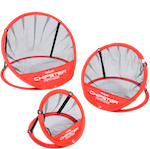
GoSports Chipster is a three-target pop-up chipping net system. It offers genuine variety that most chipping practice setups lack. Instead of a single fixed target, you receive three nets in different sizes: large, medium, and small.
Here’s why that matters. Chipping to the same target from the same distance, session after session, builds a very narrow skill. The real short game requires you to adjust constantly — different distances, different landing zones, different trajectories. Chipster’s three-target format lets you set up mini-courses in the garden or living room. You can move targets and practice landing the ball in progressively smaller zones as your accuracy improves.
The pop-up design means setup takes seconds — unfold, position, and you’re ready. It packs back into a supplied carry case that fits easily in a car boot or cupboard. Outdoors on grass it’s fine with real golf balls; indoors it works with foam balls, which are included. The light plastic build holds up in calm weather. For wind, secure with pegs or a weight.
For club golfers who want a flexible, packable chipping target that encourages varied practice rather than mindless repetition, this is a well-thought-out option at a sensible price.
- PROS:
- Three separate target sizes create a varied practice environment — work on landing zones from different distances and angles rather than chipping to a single fixed target.
- Pop-up design sets up in seconds and packs into a carry case for easy storage and transport.
- Works indoors with foam balls or outdoors with real golf balls — practical for year-round use.
- CONS:
- Lightweight construction may need anchoring in windy conditions — not ideal for exposed outdoor locations without pegs or weights.
SCORE: 8/10
CHIP-IT Dynamic Golf Training Aid
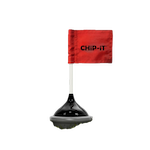
CHIP-IT Dynamic Golf Training Aid
The CHIP-IT Dynamic Golf Training Aid takes a different approach from every other product on this list. Instead of a net or a fixed target, it uses throwable yard flags as landing zones — you place them at varying distances, chip to land the ball on or near them, then move them to a new position. No assembly, no frame, no containment. Just targets on the ground.
The concept is closer to on-course practice than anything a net can offer. On the course, you’re always chipping to a specific landing spot — a patch of green a few feet past the fringe, a flat area short of a slope — and judging the carry and roll from there. The CHIP-IT flags replicate that kind of thinking. You set your target, commit to a landing spot, and execute. It’s a simple idea but a genuinely useful one for golfers who want to practise the decision-making part of chipping, not just the mechanical motion.
The obvious limitation is space. Without any ball containment, you need an open outdoor area — a garden, a park, or a short-game area at your course. It’s not suitable for indoor use and won’t work in a small space. But for golfers who have access to outdoor practice space and want to add structure and variety to their short-game sessions, this is one of the most flexible and portable chipping aids available.
- PROS:
- Throwable target flags allow instant repositioning — create varied landing-zone drills without any fixed setup or assembly.
- Encourages the kind of target-focused thinking that translates directly to on-course chipping decisions.
- Extremely lightweight and packable — fits in a golf bag pocket and adds almost nothing to carry.
- CONS:
- No ball containment — requires open outdoor space and is not suitable for indoor practice.
- Less structured feedback than a net-based system; relies on the golfer to self-assess landing accuracy.
SCORE: 7/10
DURARANGE Pop-up Golf Chipping Net
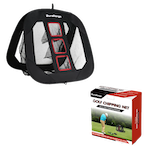
The DURARANGE Pop-up Chipping Net stands out from the other net-based options on this list for one practical reason: it comes as a complete kit. Alongside the pop-up net itself, you get two dual-sided turf hitting mats, a set of real-feel practice balls, foam balls, and tees — everything you need to start practising straight out of the box, without a separate trip to buy accessories.
The net features multiple target pockets and side containment panels, which means shots that miss the central target are still caught rather than scattering across the room or garden. That containment is more useful than it sounds — it keeps practice flowing without constant ball retrieval, which matters when you’re trying to build rhythm across a session.
The pop-up frame sets up in seconds and collapses flat for storage or transport. It’s compact enough for indoor use in a living room or garage, though the net size limits you to short chipping and pitching rather than longer shots. The two hitting mats are the more durable option for indoor sessions — they protect hard floors and give a consistent striking surface that bare carpet can’t match.
For golfers who want a ready-to-go indoor short-game setup without sourcing each component separately, the DURARANGE kit is excellent value and avoids the compromises of cheaper single-target alternatives.
- PROS:
- Complete kit includes hitting mats, real-feel practice balls, foam balls, and tees — nothing extra to buy before you can start practising.
- Multiple target pockets and side containment panels catch wayward shots and keep practice flowing without constant ball retrieval.
- Pop-up frame sets up and packs away quickly — suitable for indoor and outdoor use.
- CONS:
- Net size suits short chipping and pitching only — not designed for longer pitch shots or half-swings.
SCORE: 8/10
CHAMPKEY Double Sided Golf Chipping Net
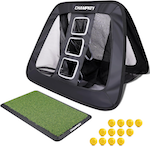
The CHAMPKEY Double Sided Chipping Net does something straightforward well — it gives you two practice surfaces in one pop-up frame. One side is configured for standard chipping practice; the other offers a different target layout, so you can flip the net and work on a different type of shot without moving or resetting your practice area.
The net comes with a heavy-duty rubber-backed hitting mat, which is a more useful inclusion than the foam mats supplied with some alternatives. The rubber backing keeps the mat firmly in place on hard floors during repeated chip shots — a minor detail that becomes noticeably important when you’re hitting dozens of shots in a session and the mat keeps sliding forward. Foam practice balls are also included, making it safe for indoor use without worrying about ricochets off walls or furniture.
The main trade-off with foam balls is feedback. Outdoors with real golf balls, you get genuine feel and flight data from each chip. Indoors with foam balls, the ball behaves differently off the face and doesn’t replicate the roll or bounce of a real ball after landing. For pure strike and target practice indoors this isn’t a problem, but golfers who want to replicate on-course feel as closely as possible should use real balls outdoors when conditions allow.
At this price point, the double-sided design and quality hitting mat make the CHAMPKEY a competitive option among the pop-up net alternatives on this list.
- PROS:
- Double-sided net provides two different target layouts in a single frame — more practice variety without additional equipment.
- Heavy-duty rubber-backed hitting mat stays firmly in place on hard floors during repeated use.
- Foam practice balls included for safe indoor use in confined spaces.
- CONS:
- Foam balls limit feedback compared with real golf balls — best supplemented with outdoor sessions using real balls when possible.
SCORE: 7/10
Dr. Golf Swing Trainer Aid
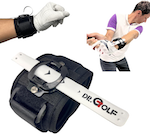
The Dr. Golf Swing Trainer Aid is the only product on this list that doesn’t involve a net or a target — it’s a wrist-worn training band designed to address the most common mechanical fault in amateur chipping: the breakdown of the lead wrist through impact.
Here’s the problem it solves. A solid chip shot requires the lead wrist to stay flat or slightly bowed through impact, maintaining the loft of the club and delivering a clean, descending strike. Most club golfers do the opposite — they scoop or flip the wrists through impact in an attempt to help the ball into the air, which adds loft, loses compression, and produces the thin and fat strikes that cost shots around the green. The Dr. Golf band wraps around the wrist and provides tactile feedback when the wrist breaks down, making the fault immediately noticeable rather than something you only spot on video later.
It’s an adjustable strap, so the sensitivity and fit can be set to suit different users. It’s light enough to use throughout a chipping practice session without getting in the way, and small enough to carry to the range or the course practice green without taking up meaningful space.
The limitation is scope. This is a single-fault trainer — it works on wrist position and nothing else. It won’t help with alignment, distance control, trajectory, or strike path. But for golfers who’ve been told by a coach that they flip or scoop through the ball — or who recognise that fault in their own game from thin and fat contact — it addresses the root cause more directly than any amount of net practice will.
- PROS:
- Targets the most common chipping fault directly — wrist breakdown through impact — rather than just providing a target to aim at.
- Adjustable strap suits different wrist sizes and sensitivity preferences.
- Lightweight and compact — easy to use during any chipping practice session at home, on the range, or on the course practice green.
- CONS:
- Single-fault trainer only — addresses wrist position and nothing else. Won’t help with distance control, alignment, or trajectory.
- Feedback quality depends on correct fitting and consistent use — worth spending time setting it up properly before the first session.
SCORE: 6/10
Frequently Asked Questions
What’s the best way to practise chipping at home?
The most effective home chipping practice combines a consistent striking surface, a defined target, and structured repetition. A hitting mat gives you a reliable lie every time — bare carpet is inconsistent and gives misleading feedback on strike quality. A pop-up net or target system gives you something to aim at, which turns aimless hitting into purposeful practice. From there, the key is variety: change your distance, change your target, and work on different trajectories rather than chipping the same shot repeatedly. Ten minutes of focused, varied chipping practice is worth more than an hour of mindless repetition.
Can I practise chipping indoors?
Yes — and for most club golfers, indoor practice is the most realistic way to build consistency, because it removes the excuses that come with weather and travel. Pop-up nets like the GoSports Chipster, DURARANGE, and CHAMPKEY are all designed for indoor use with foam or real-feel practice balls. The Dr. Golf wrist trainer works anywhere without needing any balls at all. The one product on this list that doesn’t suit indoor use is the CHIP-IT, which requires open outdoor space for the throwable flags to work properly. For indoor sessions, a hitting mat is worth adding if it’s not included with your net — it gives more consistent feedback on strike quality than chipping off carpet.
What causes thin and fat chip shots?
Both faults usually come from the same root cause: the wrists breaking down through impact. When the lead wrist cups or flips through the hitting zone — often in an attempt to help the ball into the air — the club’s effective loft increases and the low point of the swing moves behind the ball. Hit behind the low point and you get a fat shot; catch the ball on the upswing and you get a thin. The fix is to keep the lead wrist flat through impact and let the loft of the club do the work. A training aid like the Dr. Golf wrist band gives you immediate feedback when the breakdown happens, which is more effective than trying to feel it on your own.
Do I need a special mat for chipping practice?
Not essential, but recommended. A good hitting mat gives you a consistent, repeatable lie for every chip shot, which means your feedback on strike quality is reliable — if you hit it fat, you know it was the swing, not the grass. Bare carpet gives inconsistent results because it can mask a slightly heavy strike that would cost you on the course. Several products on this list include hitting mats as part of the kit (DURARANGE and CHAMPKEY both do), which is worth factoring into the value comparison when choosing between them.
How much short-game practice do I actually need?
More than most club golfers do — putting and chipping together account for roughly 60% of shots in a typical round, yet most golfers spend the majority of their practice time on the full swing. Even 15 minutes of focused chipping practice before a round, or two or three short home sessions per week, will produce noticeable improvement in scoring within a few weeks. The key is that it’s focused practice — with a specific target, a defined landing zone, and attention to the result of each shot — rather than aimlessly hitting balls into a net. Quality of repetition matters far more than quantity.