
About Me
My name is Steve. I’m 58 years old, I’ve been playing golf for nearly 40 years, and I’m a member at Clandon Regis Golf Club in Surrey with a WHS handicap index of 9.0.
I grew up on council estates in South East London in the 70s and 80s. Golf wasn’t exactly part of the landscape. My introduction to the game was a 1-iron my uncle gave me, which I used to knock balls around the football fields near where I lived with a couple of mates. We were hitting it 100 yards on a good day, and we thought we were Seve!
My First Round
My first proper game came at 19, at Beckenham Place Park — a pay-and-play course in south London where you turned up in jeans, hired a set of clubs, and queued for a tee time like you were waiting for a bus.
I took out a 3-iron on the first tee, closed my eyes, and swung as hard as I possibly could. The result was a weak shank into a greenside bunker on the second hole, about 30 yards away. A collective groan went up from the long queue of golfers behind me.
I asked my mate’s relative — the one who’d actually played before — what I should do. He told me to just throw it out of the bunker. So I did. I picked up the ball and hurled it 60 yards up the fairway.
That was the hook.
Learning the Hard Way
Growing up where I did in the 80s, golf lessons weren’t on the agenda. There were no public driving ranges nearby, training aids barely existed, and the idea of getting proper instruction just wasn’t realistic. So I taught myself, which meant developing the most ridiculous overswing you’ve ever seen. It made John Daly look like Jon Rahm. I could see the clubhead out of my left eye at the top of my backswing — and it felt like it was heading for my left knee.
I played as a pay-and-play golfer through the 90s and early 2000s, gradually getting better, reading books on the swing, and picking up the occasional lesson.
In the late 90s I got lucky with my day job. I worked on graphics for Sky Sports and covered the Players Championship, the US Open, the US PGA, the Tour Championship, and two Ryder Cups — Valderrama and Brookline. Standing at the first tee at TPC Sawgrass alongside Butch Harmon, watching Tiger Woods tee off, is not something you forget. Watching the best players in the world work on the range during practice days only deepened my interest in how the game is actually played.
Joining a Club — and Breaking My Wrist
By the mid-2000s I was playing more regularly and eventually joined Hampton Court Palace Golf Club in 2009. It’s a beautiful setting — flat, but it plays like an inland links when the rough is up and the wind is blowing. The fallow deer have free roam of the park and frequently wander onto the fairways, which adds a unique element to course management.
In 2011 I found an accidental cure for my overswing. I fell heavily while running for a bus and broke my right wrist badly. Once I was out of the cast and through physio, I got back on the range and discovered my swing was shorter. I was hitting draws. I’ve never gone back to the overswing since.
As I played more & more, I started experimenting with training aids in earnest — SuperSpeed sticks for clubhead speed, a SKLZ Gold Flex for tempo and strength, alignment sticks, and a grip trainer. Which is, in a roundabout way, how this site came to exist.
The Mental Game
One thing I’d pass on to any club golfer is the lesson that made the biggest difference to my game — and it wasn’t about the swing at all.
I used to be a nightmare on the course. Club-throwing, swearing at myself, the whole thing. During a lesson around 2009, a pro walked me through a series of questions about my game. When he joined the dots, instead of a circle he got a crescent moon. His point was clear: the biggest problem was the six inches between my ears.
He gave me a simple exercise that I still use. After every shot — every single one — I had to say out loud one of three things:
EXCELLENT — The ball came out of the middle, went where I was aiming and the right distance.
GOOD — Slightly offline, slightly off-distance, slightly off the middle. Close, but not quite excellent.
OK — Everything else. Shanks, thins, fats, hooks, slices. However bad the shot, it’s OK.
Within a few rounds my anger had almost completely gone. I still get frustrated — I’m not a Saint — but I no longer throw clubs, and I can let a bad shot go and move on to the next one. The calmer I am, the better I play. Simple as that.
If you haven’t read Golf Is Not a Game of Perfect by Dr Bob Rotella, I’d strongly recommend it. It’s the best book I’ve found on the mental side of the game.
Clandon Regis and Getting Serious
In 2020 I left Hampton Court Palace and joined Clandon Regis Golf Club — a move I wish I’d made years earlier.
It’s a gem of a course. The greens are among the best I’ve played in Surrey — quick, true, and full of slope, so you’re constantly reading the break and learning to aim well away from the hole to give the ball a chance to drop. It’s a tight layout where a slightly errant tee shot puts you in the trees or a bunker, and the back nine can quickly undo a good front nine when the wind is against you.
More than the course, it’s a genuinely friendly club. In the years I have been a member, I haven’t been paired with anyone who wasn’t a pleasure to play with.
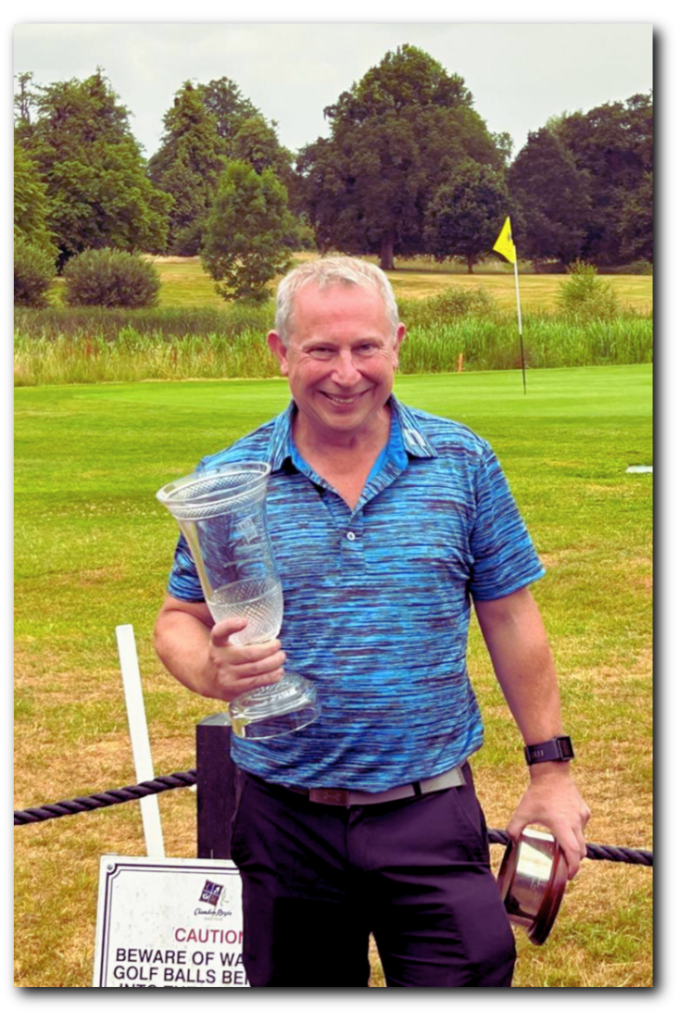
My golf has improved significantly since joining. I was a 15-handicapper when I walked through the door. My WHS index got down to 8.0 this season and currently sits at 9.0 — 10 off the whites, 7 off the yellows. I was part of the winning pair in the FourBall Better Ball knockout in 2023, and I won the Club Handicap Championship in 2025.
Why This Site
I started thegolfhacks.com because I know what it’s like to improve at golf without a coach in your ear every week, without a background in the game, and without unlimited time or money to throw at it.
How I review: I don’t physically test every product on this page. These picks are based on researching the specs, weighing up hundreds of verified Amazon buyer reviews, and applying nearly 40 years of playing experience as a 10-handicap club golfer to judge what’s genuinely worth your money
If something on the site helps you hit it straighter, hole a few more putts, or knock a shot or two off your handicap, that’s the point.
You can see the clubs I’m currently playing here.
Steve